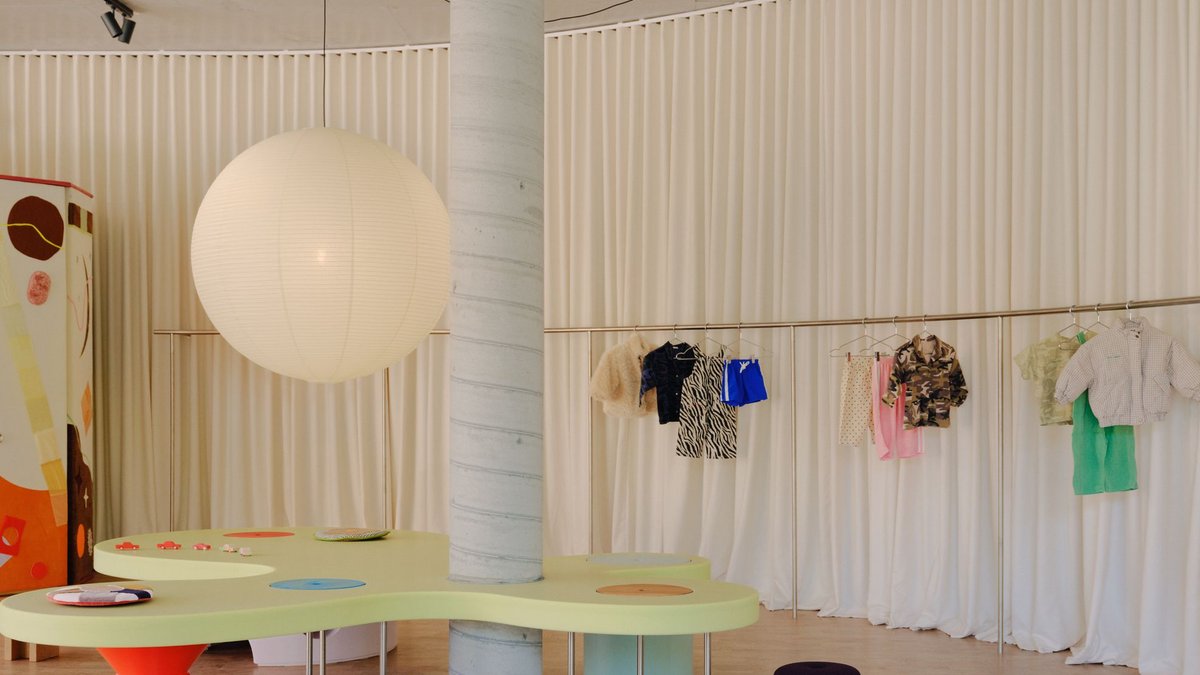
A children’s clothing store in Byron Bay, Australia, has abandoned the standard sterile, minimalist retail design in favor of an approach that feels like a child’s imaginative playground. The space rejects the polished, flawless aesthetic typically found in retail environments, instead adopting warmth and intentional imperfection.
A Bold Design Statement
The store, designed by Pattern, serves as the flagship for Ziggy Zaza, a kidswear brand launched in 2021. From its exposed concrete walls to its mismatched materials, every detail reflects the brand’s founding philosophy. The store’s entrance carries a clear message: “This is absolutely not the most perfect store you will see.” This attitude extends to the brand’s origins, which began as a side project during maternity leave. Ziggy Zaza’s permanent collection avoids seasonal trends and gendered stereotypes, with the design team stating, “Pink is for… whoever wants to wear it.” The store’s design mirrors this inclusive approach, rejecting the sanitized look often associated with children’s retail spaces.
Smart Use of Space and Budget
The 200-square-meter store is nearly double the size of an average retail space, yet Pattern transformed the layout into a functional and cost-effective design. Instead of using fixed walls—a costly and time-consuming process—they installed a single, flowing off-white linen curtain. This simple solution created a 70% shop floor while also defining a practical back-of-house area, all without major renovations.
Additional cost-saving measures included retaining the original concrete walls and the existing black track lighting, which the designers describe as “ugly.” The floor features honey-toned cork tiles arranged in organic curves, softening the industrial aesthetic. These choices resulted in a space that feels purposeful rather than overdesigned. The materials also improved acoustics, as the curtain and cork absorbed sound, reducing the echo that would otherwise dominate a bare concrete space. Even the lighting remains functional rather than purely decorative.
Playfulness as the Foundation
Every element within the store references childhood play and exploration. Oversized paper lanterns hang like mobiles, while geometric cutouts in the joinery mimic the object permanence toys used by babies. A custom activity table and a point-of-sale desk shaped like stacked blocks pay homage to toddler building sets. Pattern happily admit the POS desk looks a bit like a BBQ Shape (the savoury Arnott’s biscuit, for our international friends), and they’re not wrong.
Artwork is integrated throughout the space rather than confined to galleries. A 1960s LT305 Lotus Lamp by Carlo Nason for Mazzega sits on the POS, deliberately avoiding the sterile treatment often applied to children’s spaces. The fitting rooms feature a purple-carpeted lunar environment with a rocket-ship cubby, serving as a second fitting area. The glow of the carpet is visible from the street, drawing attention to the store’s playful design.
Even functional elements incorporate playfulness. A clothes rail swings like a Hills Hoist, evoking Australia’s iconic backyard clothesline. A hat display in Kawasaki orange acts as a megaphone, described by Pattern as “loud, literally and visually, and utterly unapologetic.” Hidey holes stocked with colored pencils and wooden cars encourage exploration, further breaking from traditional retail norms.
Local artists contributed to the store’s unique character. The Dusty Road created an abstract collage from discarded fabric on an octagonal fitting room, while surfer and artist Ozzy Wright painted a mix championing animals over robots and covered shelving with punk-style poetry and characters. Pattern’s co-director, Lily Goodwin, explained the design’s purpose: “The point was to build a world for kids that celebrated their curiosity, inquisitiveness, uniqueness and joyous expression.” It was also, she added, “to show that design for children needn’t infantilise or talk down to them.”
Pattern say they hope to design ten more Ziggy Zaza stores, “or even 100, if they’ll have us.” I’d happily write about every one of them.
