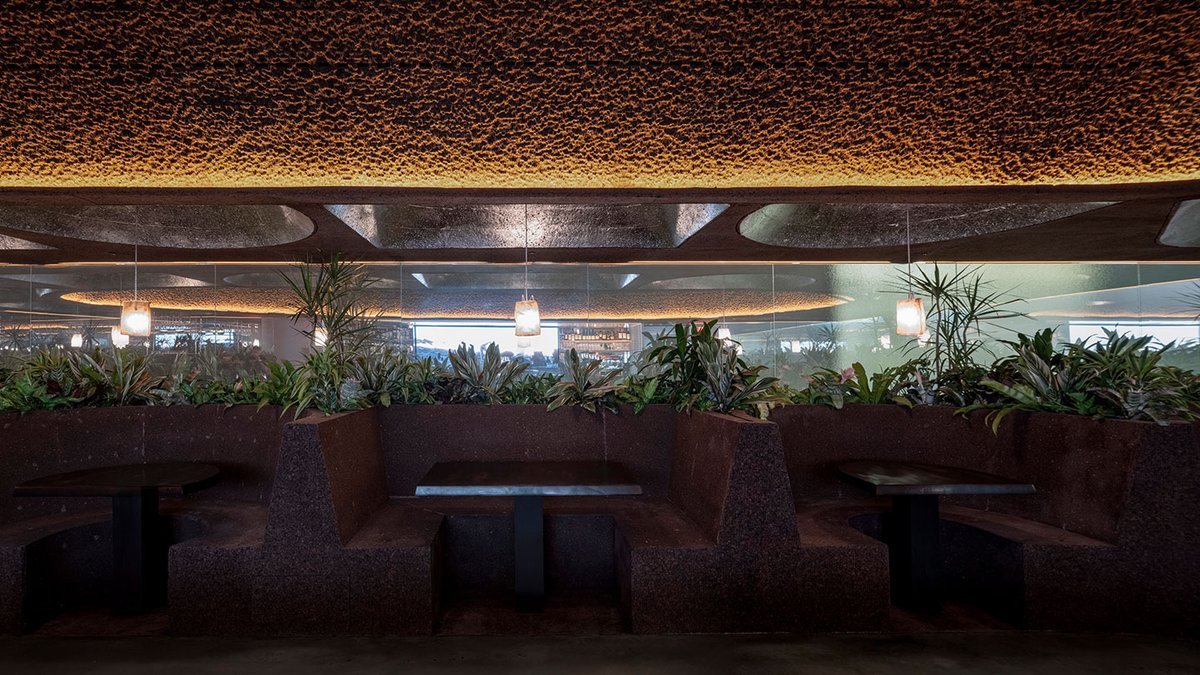
The New Museum’s newest restaurant, Oberon, blurs the line between dining and art installation. Tucked inside the museum’s angular addition in Lower Manhattan, the space uses cork instead of metal as its defining material, creating what its designers call a “mystical grotto” that feels more organic than the rest of the building’s industrial aesthetic.
A restaurant that doubles as an art exhibit
The 120-seat restaurant and cocktail bar occupies a freestanding cube wrapped in silver leaf-treated cork. Opaque windows offer glimpses of leafy planters inside. By day, it functions as a café accessible through the museum’s atrium. By night, it transforms into a full-service restaurant, reached through a graffiti-lined alleyway.
The dual identity was intentional. OMA, the firm behind the project, designed both the restaurant and the museum’s 5,574-square-meter expansion. The space doesn’t just resemble an extension of the museum’s avant-garde exhibitions—it actively participates in them.
At the end of each meal, diners receive a chocolate created by artist and musician Laurie Anderson. Behind the bar, a video piece by Ian Cheng plays on loop, its AI-generated animation shifting constantly in unpredictable ways. The work, part of Cheng’s “simulations” series, doubles as ambient lighting for the space.
Minjae Kim, a New York-based Korean artist, contributed hand-sculpted ash dining tables and a bar top, along with resin-dipped fiberglass light fixtures. Kim described the pieces as “intentionally imperfect,” favoring texture and craftsmanship over pristine finishes.
Sustainability as a design principle
Oberon is the latest project from the Oberon Group, a hospitality company that operates carbon-negative restaurants. The menu emphasizes plant-based ingredients sourced from the Hudson Valley. The design mirrors this commitment: the cork, supplied by Portuguese manufacturer Sofalca, is biodegradable and absorbs carbon while improving acoustics in the cavernous space.
A large domed cork ceiling anchors the dining room. Smaller CNC-milled cork domes, each finished with silver leaf, hang above the booths. The material’s warmth contrasts with the museum’s industrial palette, reinforcing the restaurant’s identity as both part of the institution and a distinct experience.
The choice to use cork wasn’t just about appearance. Its natural properties align with the restaurant’s zero-waste goals, demonstrating how sustainability and high-concept design can work together. The approach could have felt forced, but the subtle, textured execution makes it a natural fit for a museum known for pushing boundaries.
If the trend of supper clubs doubling as art installations continues, Oberon’s model suggests the next phase may prioritize materials that serve multiple roles—functional, sustainable, and visually compelling. The restaurant now serves as an experiment in how far a dining experience can stretch without losing its core appeal.
The question of whether diners arrive for the art or the food remains unanswered. Still, the space offers a glimpse into how design choices can shape both aesthetics and environmental impact in hospitality.
For those interested in sustainable materials, similar innovations appear in residential projects, such as homes built from recycled rice husk panels.
