The Pacific Northwest has long drawn designers and homeowners who want their houses to feel integrated into the setting, not something dropped onto it. The Cascade Mountain range splits the region — Idaho, Washington and Oregon — into two distinct worlds. To the west, rainforests and rugged coastlines frame major cities. To the east, high-elevation deserts stretch under open sky. Even in urban centers like Seattle, nature asserts itself. On clear days, residents say “the mountain is out,” referring to Mount Rainier, a massive volcano nearly 100 miles away that appears close enough to touch.
That connection to the environment shapes how homes are built here. Wood, water and stone — the raw materials of the region’s topography — define the architecture. In skilled hands, these elements combine to create dwellings that look like they belong, whether perched on a wooded hillside, a rocky slope or a waterfront lot.
Wood doesn’t have to mean dark or traditional
The Pacific Northwest’s wet climate and rich soil produce enormous conifers. In the 19th century, the Gold Rush sparked a lumber boom that made logging central to the regional economy and gave rise to the term “King Timber.” Today, the region remains a top lumber producer, and wood still plays a central role in home design — but not in the heavy, dark way some might expect.
Related: Tropical Modern Home Features Serene Design
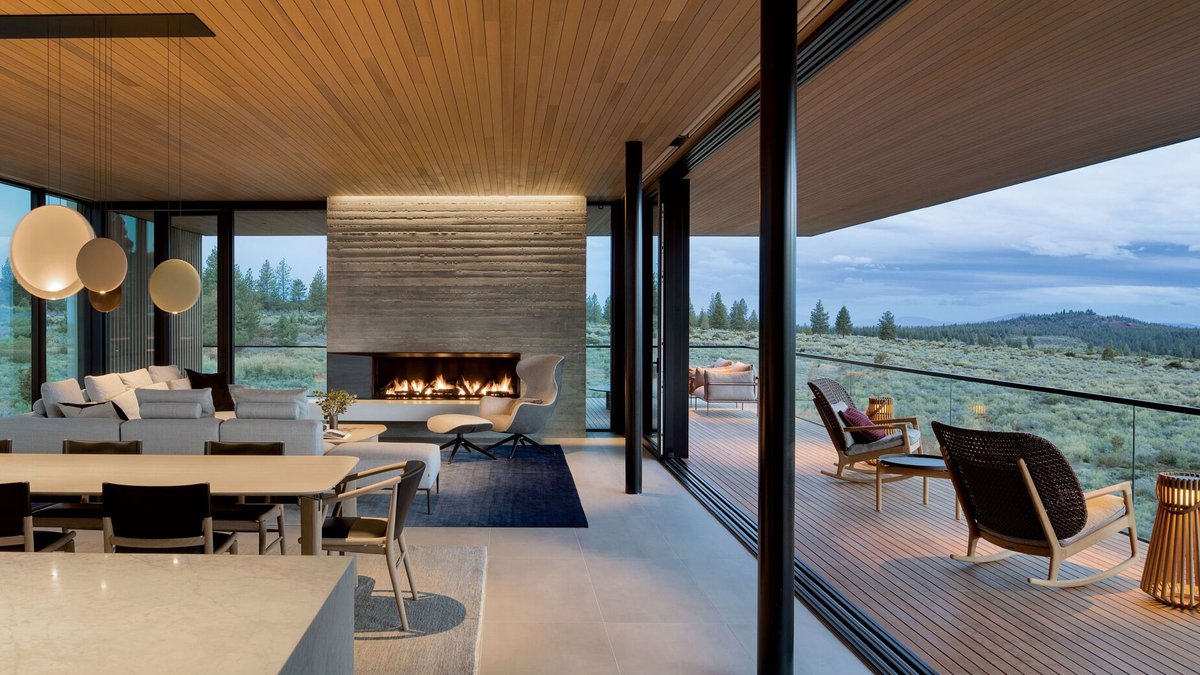
Two projects show the shift. A Bend, Oregon, house by Scott Edwards Architecture and a Bainbridge Island residence by Hoedemaker Pfeiffer both use wood in lighter, brighter ways. Accents appear on ceilings, beams and exterior siding. “In the Pacific Northwest, Modernism found a more human expression: houses of wood, light and setting that feel calm, grounded and deeply connected to the natural world,” said architect Steve Hoedemaker.
74% of designers working in the Pacific Northwest say their clients prefer natural earth tones, with contemporary and organic styles also in high demand.
Sheltered outdoor spaces for a rainy climate
It rains a lot here. The Pacific Northwest is home to some of the wettest spots in the continental United States. But designers don’t fight the weather — they work with it. They let light flow inside at every opportunity and create sheltered outdoor living and dining areas that let homeowners be outside regardless of conditions.
Related: Design Editor Shares Airbnb Travel Tips
In Bend, which sits in the high desert and gets more snow than rain, architects Rick Berry and Ryan Yoshida of Scott Edwards Architecture designed a pair of covered, raised decks. The decks seem to float above the setting, offering protection while keeping residents close to nature. “The sheltered decks become spaces for year-round living,” Berry said.
This practical approach to climate is one reason the region’s architecture feels grounded. It’s not about conquering the elements but finding a way to live with them. The late Seattle interior designer Jean Jongeward, sometimes called the “queen” of design in the region, described the area as “this soft green place, like something in a poem.”
With nearly 5,000 miles of shoreline across Washington and Oregon, architects have also made an art of connecting waterfront homes to the water. Hoedemaker’s waterfront residence on a peninsula offers multiple sheltered and open places to sit and take in the setting. The house sits low and quiet, letting the view do the work.
